
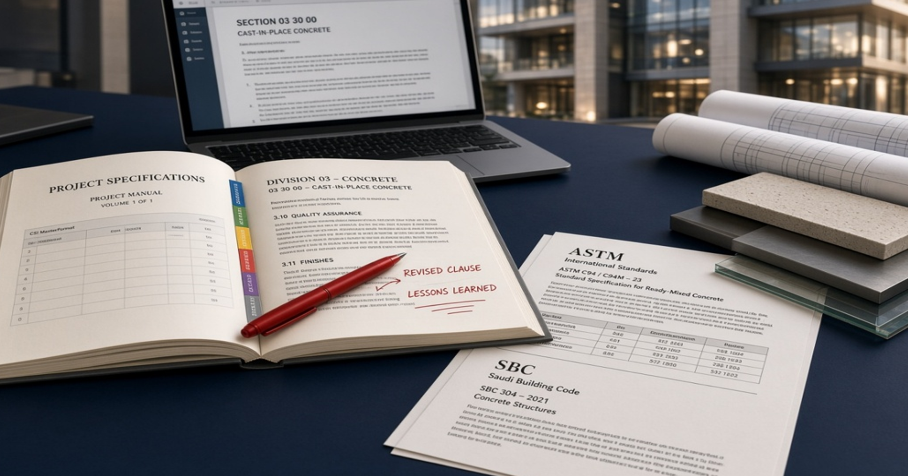
Updated Standards Are Essential: How a Specification Writing Company Raises Project Quality with Lessons Learned
Best Specs Writing Company in GCC and USA | Updated Standards & Lessons Learned | FIPC
FIPC is a specification writing company serving the GCC and USA. Learn why updated construction standards and project lessons learned improve quality, reduce risk, and keep specifications tender-ready.
In construction, drawings show what a project looks like. Specifications decide how it is built. Materials, workmanship, testing, warranties, and code compliance live in the written word, not on the sheet. When those words are outdated, incomplete, or copied from a previous project without review, quality drops and claims rise.
That is why updated standards are essential for any project, and why a dedicated specification writing company should treat every completed job as a source of lessons learned. FIPC – Farzan International Project Consultant has provided this service since 2008 across Saudi Arabia, the UAE, and the United States. The practice exists to keep project manuals current, coordinated, and enforceable.
Why Specification Writing Still Decides Project Quality
A specification is a contractual instrument. It tells the contractor what product to buy, which test to pass, which standard to follow, and what happens if the work fails. Drawings cannot carry that load alone. Poor specifications produce substitutions that were never intended, inspections that cannot be enforced, and disputes that consume the contingency.
Working with the best specs writing company in GCC and USA markets is not a branding claim. It is a practical requirement when projects must satisfy two different regulatory worlds at once: SBC, SASO, and local authority practice in the Gulf; AIA MasterSpec, CSI MasterFormat, ASTM, NFPA, and AHJ review in the United States.
Updated Standards Are Essential for Every Project
Codes and product standards do not stand still. Saudi Building Code editions change. SASO conformity requirements tighten. ASTM test methods are revised. NFPA fire provisions move. Superpave replaces older mix-design language. Crash-rated barrier criteria under ASTM F2656 and MASH are updated. A specification that still cites a withdrawn standard is already a defect.
Updating standards inside the specification does three things at once:
- It protects life safety and authority approval.
- It aligns procurement with products that can actually be certified and delivered.
- It reduces the gap between design intent and constructed result.
A specification writing company that does not maintain a living standards library is writing yesterday’s project. FIPC treats code and standard updates as a core production task, not an afterthought at tender.
Standards that typically require a live review
- CSI MasterFormat structure and Division 01 general requirements
- AIA MasterSpec and SpecsIntact language for US federal and commercial work
- Saudi Building Code (SBC) and SASO product conformity
- ASTM, EN/BS, ISO material and test methods
- NFPA, IEC, and local fire/electrical authority rules
- Project-specific performance criteria (façade, barriers, waterproofing, MEP commissioning)
Lessons Learned Must Feed the Next Specification
The most expensive knowledge on a project is the knowledge that is never written down. RFIs that revealed ambiguous wording, substitutions that exposed an outdated product list, failed tests that showed a weak acceptance clause, and site comments that identified missing coordination, these are assets. They should update the master, not sit in an email thread.
A disciplined specification writing company closes that loop:
- Capture field and tender comments against the relevant CSI section.
- Record which clause caused the issue: product, execution, testing, or warranty.
- Revise the master specification and the project-particular overlay.
- Brief the next project team so the same defect is not reissued.
This is how quality increases over time. Each project should leave the specification library stronger than it found it. That is the opposite of recycling an old PDF and changing the project name.
How Updated Specs Raise the Quality of the Work
Quality is not a slogan in Division 01. It is a set of measurable requirements: sample submittals, factory tests, field tests, mock-ups, hold points, and warranties that can be enforced. When standards are current and lessons learned are written into those clauses, the contractor knows the bar before mobilization.
Practical effects include:
- Fewer RFIs caused by conflicting or obsolete references.
- Cleaner tender comparisons because bidders price the same performance.
- Stronger inspection because acceptance criteria are testable.
- Better coordination between architectural, structural, MEP, and landscape sections.
- Lower commercial risk when substitutions are controlled instead of improvised.
A Working Method, Not a Template Dump
Good specification writing follows a repeatable sequence:
- Review drawings, design intent, and the applicable code set for the jurisdiction.
- Map materials and systems to current standards and available certified products.
- Draft CSI-structured sections with coordinated language across disciplines.
- Audit for conflicts, withdrawn standards, and missing test/warranty clauses.
- Issue a tender-ready manual and remain available for RFIs and addenda.
- Return lessons learned into the master after construction.
That last step is what separates a living specification practice from a one-off document mill.
Conclusion: Quality Is Written Before It Is Built
Updated standards are essential for any project. Lessons learned from the last project are how those standards stay useful. Together they increase the quality of the work, protect the client’s intent, and reduce the cost of confusion.
If you need a specification writing company that operates in both the GCC and the USA—and that treats every completed project as an update to the next manual—FIPC is structured for that work. Clear specifications are not extra paperwork. They are the quality system in written form.
What Clients in the GCC and USA Should Expect
FIPC works as an independent specification writing company, not a product vendor and not a contractor. That independence matters when the specification must remain brand-neutral, performance-based, or tightly prescriptive by client instruction.
Typical deliverables include master specifications, project-particular specifications, technical sections, specification audits, CSI MasterFormat project manuals, BOQ coordination, and support through tender and construction. Work covers architectural, interior, structural, MEP, civil, landscape, and specialized systems.
Offices and operating hubs:
- KSA — Riyadh | +966 58 065 4767
- UAE — Sharjah Publishing City Free Zone | +971 52 656 9254
- USA — 5900 Balcones Drive, Suite 100, Austin, Texas 78731 | +1 (929) 270-3672
- Email: info@faripc.com | www.faripc.com